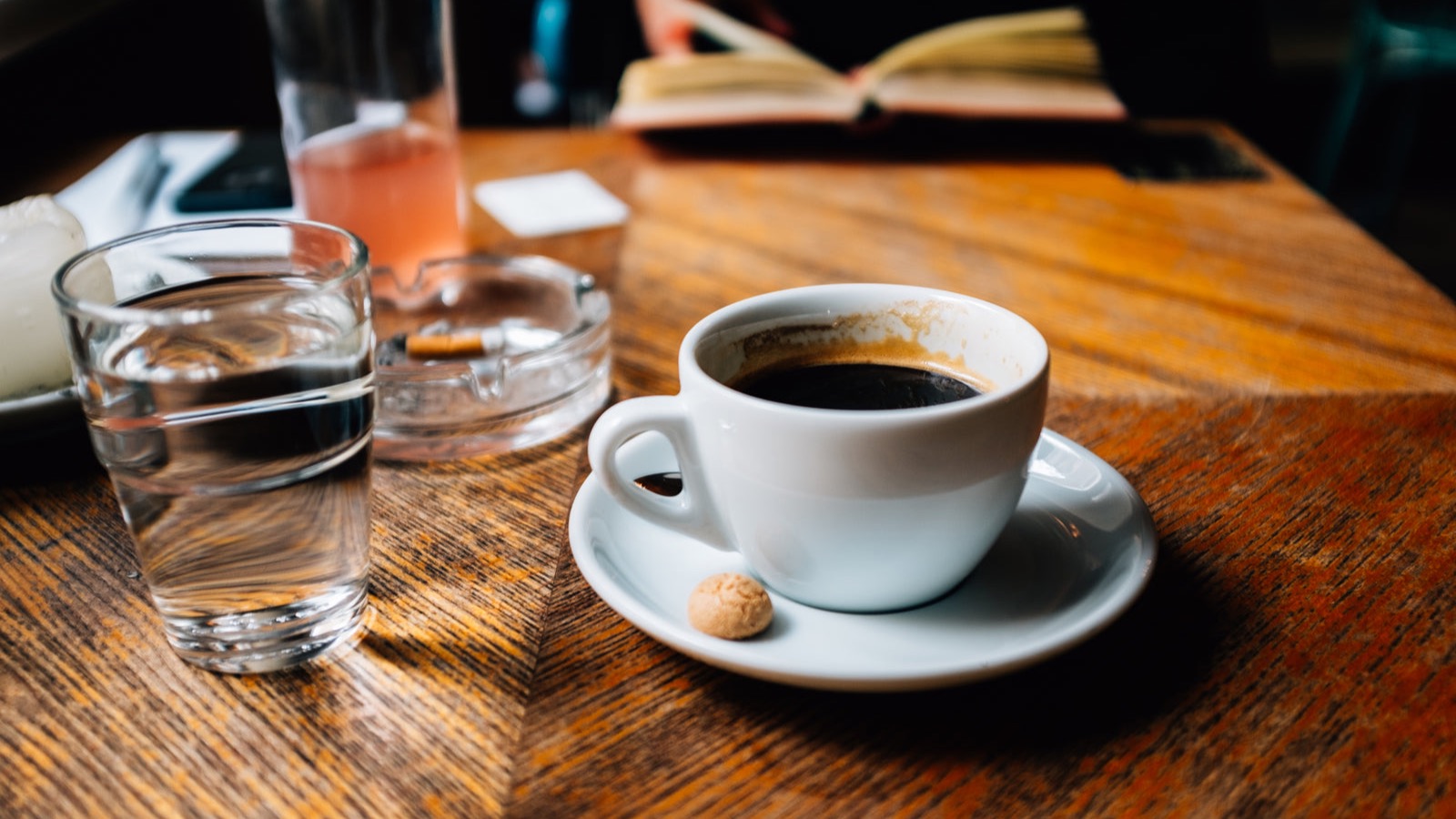
Every few months the coffee nap makes the rounds again, usually framed as a productivity hack. Drink an espresso, fall asleep for 20 minutes, wake up sharper than either coffee or a nap alone.
The strange part is that this one has actual experimental support going back almost thirty years, from a research group that was studying sleepy drivers rather than biohackers. The effect is real but smaller and more conditional than the internet version suggests.
Here is what the studies measured, why the 20-minute window exists, and how to run it without wrecking your night.
TL;DR: A coffee nap means drinking caffeine and then sleeping for 15 to 20 minutes, so the caffeine starts working as you wake. In the original study, drivers who took a 15-minute nap after a caffeinated drink made fewer errors in a driving simulator than drivers who only had caffeine or only napped. The mechanism is adenosine: sleep clears it while caffeine blocks the receptors it would otherwise bind to. The window matters, because past roughly 20 to 25 minutes you risk sleep inertia and wake up worse. Coffee naps also count toward your caffeine total, so anything after about 2 p.m. can cost you deep sleep, and a 400 mg dose taken six hours before bed measurably cuts sleep time.
YouTube: Related video
What a coffee nap actually is
It is exactly what it sounds like, minus the contradiction. You drink coffee, then immediately lie down for a short nap. You are not trying to sleep through the caffeine. You are trying to be asleep during the 15 to 30 minutes it takes for the caffeine to reach your brain, so that the two effects overlap on the way out.
The order is the whole trick. Coffee first, then nap. Not nap, then coffee, which just makes you wait.
Most people who try it get one of two things wrong: they drink a large latte (too much volume, too much milk, too slow to absorb) or they set a 45-minute alarm (too long, and they wake up in the wrong stage).
Why the timing works: adenosine and the 20-minute window
Your brain accumulates adenosine all day. It is a byproduct of neuronal activity, and as it builds up it binds to receptors that make you feel drowsy. That is the homeostatic part of sleep pressure, the one that gets stronger the longer you are awake.
Caffeine is shaped enough like adenosine to occupy the same receptors without activating them. It does not remove the adenosine, it just blocks the door. This is why caffeine works well when you are mildly tired and poorly when you are severely sleep deprived: there is a limit to how many doors you can hold shut.
Sleep does something caffeine cannot. During non-REM sleep, adenosine clears from the brain. So a short nap lowers the amount of adenosine floating around, and caffeine arriving at the same time has less competition for the receptors.
The two effects stack instead of competing. That is the entire hypothesis, and it holds up reasonably well against the data.
One timing detail worth knowing: caffeine is absorbed in the small intestine and reaches peak blood levels somewhere between 30 and 60 minutes after you drink it, with noticeable effects from around 15 to 20 minutes. That is why the nap is short. You want to be asleep while absorption is happening, and awake when it lands.
What the evidence actually shows
The study everyone cites is Reyner and Horne, published in Psychophysiology in 1997. They took sleepy drivers, gave them either a placebo, caffeine, a 15-minute nap, or caffeine followed by a 15-minute nap, and then put them in a driving simulator for two hours. The combination condition produced fewer driving errors and lower subjective sleepiness than caffeine alone or nap alone.
An earlier paper from the same lab had already shown that caffeine and napping each reduced driving impairment on their own. The 1997 study was asking whether combining them beat either one. It did, modestly.
Three things to keep in perspective:
- The samples were small. These were lab studies with a few dozen participants, not large trials.
- The participants were sleepy drivers, not rested people looking for a productivity edge. The baseline was impairment, which is where alertness interventions show the biggest effects.
- The outcome was simulator performance over two hours, not long-term anything. Nobody has run a year-long coffee nap trial, and nobody needs to.
There is also a body of work on caffeine plus naps in shift workers and night-shift nurses pointing the same direction. The general finding across that literature is consistent: caffeine helps, naps help, and the combination tends to beat either alone for short-term alertness, with the advantage shrinking as the task gets longer.
Why 20 minutes and not 60
Sleep is not one uniform state. Twenty minutes keeps most people in light sleep, stages N1 and N2, which is easy to exit. Somewhere around 30 minutes you start spending more time in slow-wave sleep, and waking from slow-wave sleep produces sleep inertia: the heavy, disoriented, worse-than-before feeling.
This is why the coffee nap and the "nap hangover" people complain about are usually the same experiment run with different alarms. If you regularly wake from a 60-minute nap feeling awful, you were waking out of deep sleep, not proving that naps do not work.
The practical implication is that the nap is a timer problem, not a sleep problem. Set the alarm for 20 to 25 minutes from the moment you put your head down, not from the moment you finish your coffee.
And if you do not fall asleep? The studies suggest you still get some benefit from quiet resting with your eyes closed, since part of the effect is simply reducing sensory input and letting arousal drop. Do not fight it.
The protocol, in order
- Make it small and fast. A single espresso, a small filter coffee, or iced coffee you can drink in under two minutes. Roughly 100 to 200 mg of caffeine. Skip the 16 oz milky drink, both for absorption speed and because you will need the bathroom instead of sleeping.
- Drink it, then lie down immediately. No scrolling, no "just finishing this email". Every minute between the last sip and closing your eyes is a minute of caffeine effect you are wasting.
- Set a 20 to 25 minute alarm before you close your eyes, so you are not doing maths half asleep.
- Dark, cool, phone face down. The point is to fall asleep fast, so remove the friction: eye mask, curtains, whatever you already use at night.
- Get up when it goes off, even if you barely slept. Standing up and getting light on your face completes the effect. Lying there for another 10 minutes undoes it.
- Do not repeat it in the afternoon. One coffee nap is a tool. Three is a caffeine habit with extra steps.
The timing table
| Time you drink it | What to expect | Verdict |
|---|---|---|
| 9-11 a.m. | Full alertness benefit, minimal impact on night sleep | Best window |
| Around 1-2 p.m. | Works, but watch total caffeine for the day | Fine if this is your last caffeine |
| 3-4 p.m. | Alertness now, measurable sleep cost later | Only if you have no other option |
| After 5 p.m. | You are borrowing from tonight's deep sleep | Skip it |
What it does to your night
This is the part the productivity version leaves out. Caffeine has a half-life of roughly five hours in most adults, and it does not care that you used it strategically at 3 p.m.
Drake and colleagues tested this directly in 2013. They gave people 400 mg of caffeine at 0, 3, or 6 hours before bed and measured sleep in the lab. Even the six-hour group lost more than an hour of total sleep time, with reduced sleep efficiency and more time awake during the night. Three hours before bed was worse. Zero was worse still.
You are probably not taking 400 mg in a coffee nap. But the direction of the effect is reliable, and it stacks with whatever else you drank that day. A morning coffee, a coffee nap at 2 p.m., and an afternoon tea puts a lot of caffeine in a body that will still be clearing it at 11 p.m.
EFSA's 2015 safety opinion puts habitual intake up to 400 mg per day for healthy adults as not a concern, and single doses up to 200 mg as fine for most people. Pregnancy guidance is lower, at 200 mg per day total. A coffee nap fits comfortably inside those numbers if it is your second caffeine hit rather than your fourth.
The wearable version of this test is simple: run the coffee nap for a week and watch deep sleep, sleep efficiency, and your resting heart rate overnight. If deep sleep drops by 15 minutes and your resting heart rate creeps up 2 or 3 bpm, the nap is costing you more than it gives.
If you want the longer version of that logic, caffeine cutoff: when to stop for better sleep covers the timing rules in more detail.
Who should skip it
- Anyone with insomnia. Adding caffeine and a daytime sleep episode to a broken night is the wrong direction. CBT-I guidance is explicit about protecting sleep pressure.
- People who are sensitive to caffeine. Slow metabolisers, which is partly genetic and partly just individual, feel a 2 p.m. espresso at midnight.
- Reflux or GERD. Lying down shortly after coffee is a reliable way to make heartburn worse.
- Anxiety and panic-prone people. Caffeine raises heart rate and can trigger palpitations, and a nap does not buffer that.
- Pregnancy. Keep total caffeine under 200 mg per day, and count the nap coffee in it.
- Anyone on stimulant medication or with an arrhythmia, unless their doctor is fine with it.
How to test it on yourself with a watch
The coffee nap is a good candidate for a personal experiment because the effect is acute and you can measure both sides of it: alertness now, sleep later.
A simple 10-day version:
- Days 1-3: baseline. No coffee nap. Note your afternoon energy on a 1-10 scale at 2 p.m. and 4 p.m.
- Days 4-8: coffee nap at the same time each day, same dose, same duration.
- Days 9-10: back to baseline.
Then look at two things. First, the subjective afternoon ratings, which is the outcome that actually matters. Second, the overnight data: deep sleep, sleep efficiency, resting heart rate, and HRV. On the mornings after a coffee nap, does your HRV come back to baseline as fast as usual? A Century daily score makes that comparison easier because it puts recovery, sleep, and strain on one screen instead of three, but a notes app and your Health app will do.
Keep the inputs stable while you test, or you will be measuring the wrong variable. Same bedtime, same training load, same caffeine total. If you change three things at once, you learn nothing.
There is more on the mechanics of short sleeps in the power nap, decoded, including why 10 minutes and 20 minutes feel so different.
If coffee is not your thing
The nap is doing half the work, so it is worth knowing what the other half is replaceable with.
- Nap plus daylight. Ten minutes of bright light on waking raises alertness through a different pathway, and it helps set your circadian timing if it is early enough in the day.
- Nap plus cold water on your face. A cheap arousal kick, mostly through the sympathetic nervous system.
- Nap plus movement. Two minutes of walking or stairs beats another cup for most people in the mid-afternoon slump.
- Decaf will not work. The effect depends on adenosine receptor blockade, not on the ritual.
If your afternoon dip is severe and daily, that is worth a different investigation. Chronic afternoon crashes usually trace back to short sleep, an irregular bedtime, or a very large lunch, and no nap protocol fixes a 5.5-hour night. Our guide to the afternoon slump goes through those causes in order.
Bottom line
The coffee nap is a real, modest, well-mechanised trick: caffeine plus a 20-minute nap beats either one alone for short-term alertness, at least in sleepy people doing boring tasks. It is cheap, it takes 25 minutes, and the failure modes are well understood.
Use it early in the day, keep the dose small, respect the 25-minute alarm, and watch what it does to your deep sleep for a week before you make it a habit. The nap is free. The caffeine is not.
Century AI helps you understand your body with a daily health score, recovery score, and sleep insights, using the watch you already wear.