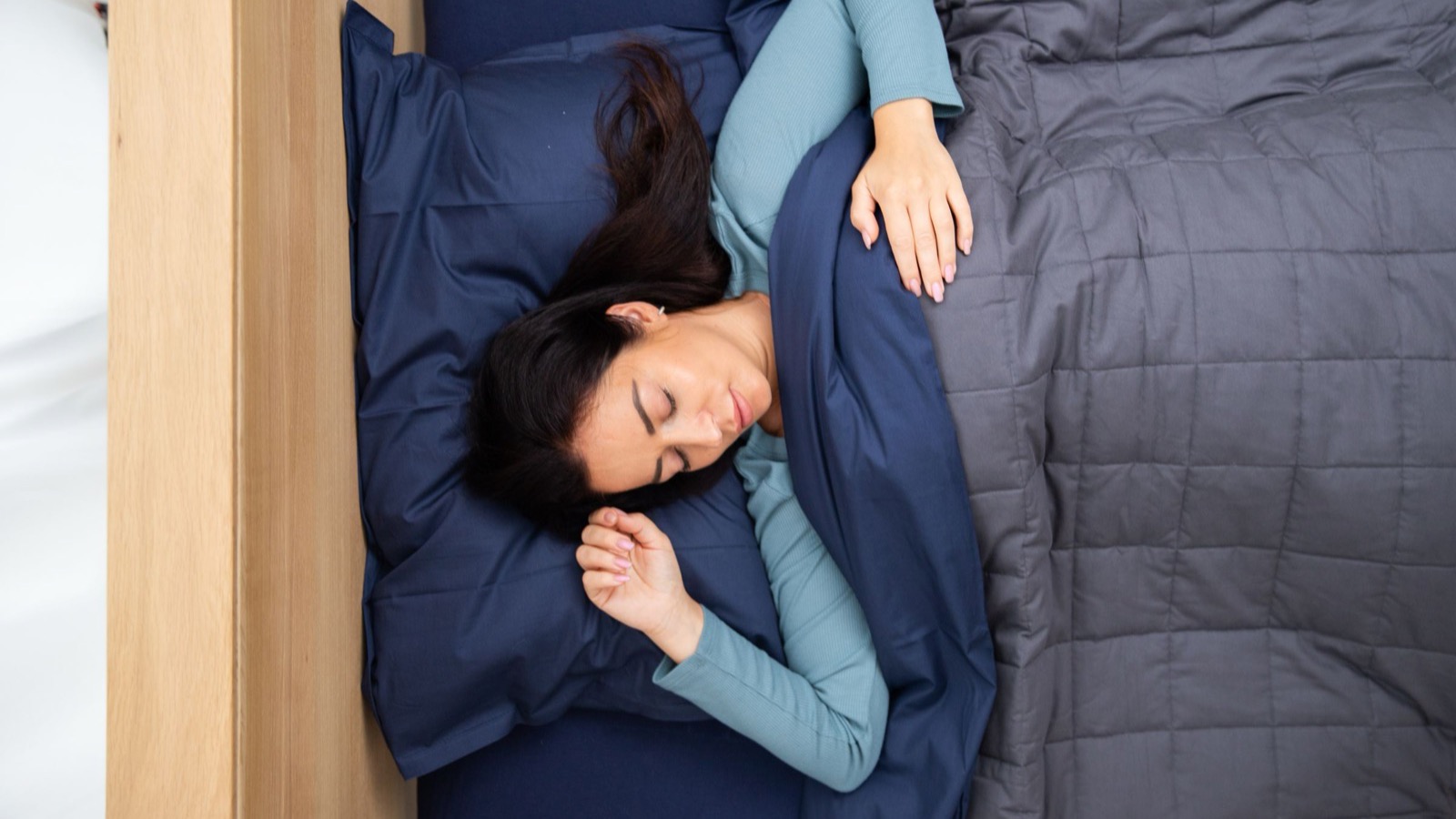
A weighted blanket is one of the few sleep products with an actual randomized trial behind it. It is also one of the most over-marketed products in the sleep aisle, sold with promises about anxiety, cortisol, deep sleep and "grounding" that the evidence does not support at that strength.
Both things are true at once. So the useful question is not "do weighted blankets work?" but "for whom, how heavy, and does it work for you?"
This guide covers the real trials, the honest caveats, the practical details that decide whether you will actually keep using one, and a two-week test you can run with your watch.
TL;DR: The best evidence comes from a 2020 randomized trial of 120 psychiatric outpatients, where an 8 kg weighted chain blanket outperformed a light blanket on insomnia severity over four weeks, with a large effect size and better sleep maintenance. A 2024 meta-analysis of nine studies found a moderate effect on anxiety (SMD -0.47) but noted that sleep studies are small, heterogeneous, and mostly not well blinded. For adults, 6 to 10 kg is the practical range, and the 10% of body weight rule is marketing, not science. The most common reason people stop using one is heat. Do not use one for infants or anyone who cannot remove it themselves. If you have chronic insomnia, a weighted blanket is a comfort tool, not a treatment: CBT-I comes first.
YouTube: Related video
What a weighted blanket is actually doing
The idea comes from occupational therapy, where deep pressure has been used for decades with children and adults who find firm, evenly distributed pressure calming. The mechanism usually proposed is proprioceptive input: pressure on the skin and joints that shifts the nervous system toward a parasympathetic state.
That story is plausible and partly supported. What is less supported is the confident marketing line that a weighted blanket "raises melatonin" or "lowers cortisol by 30%." The studies that measured physiology directly have generally found small changes at best. Subjective calm and sleepiness improve more reliably than heart rate variability or EEG patterns do.
So think of it as a comfort intervention with a real behavioural effect, not a pharmacological one. It makes lying still feel better, which makes falling asleep easier for some people. That is a legitimate benefit. It is just not the same as fixing a sleep disorder.
What the research actually shows
The trial everyone cites
The strongest study is Ekholm and colleagues' 2020 randomized controlled trial in the Journal of Clinical Sleep Medicine. They randomized 120 psychiatric outpatients with insomnia, one to one, to sleep under either a weighted metal chain blanket or a light plastic chain blanket for four weeks.
The weighted blanket clearly won:
- Insomnia Severity Index scores improved significantly more with the weighted blanket (p < .001), with a very large effect size (Cohen's d of 1.90).
- Sleep maintenance improved, meaning fewer long wake-ups in the second half of the night.
- Daytime activity levels rose, and daytime fatigue, depression and anxiety scores fell.
- No serious adverse events were reported.
- In a 12-month open follow-up, people who kept using the weighted blanket maintained the benefit, and people who switched from the light blanket to the weighted one improved in a similar way.
That is an impressive result, and it is the reason weighted blankets have any clinical credibility at all. Read the details, though: the participants all had a psychiatric diagnosis (major depression, bipolar disorder, generalized anxiety disorder or ADHD) and all had insomnia. This was not a study of healthy adults who sleep fine and want to sleep slightly better.
The meta-analyses
When you pool the smaller studies, the picture softens. A 2024 systematic review and meta-analysis in the Journal of Psychiatric Research combined nine studies covering 553 psychiatric inpatients and outpatients. The authors found a moderate effect on anxiety symptoms compared with placebo (SMD -0.47, 95% CI -0.68 to -0.25). Four of the nine studies reported improvements in insomnia, total sleep time or sleep onset latency.
Their own conclusion is the important part: the literature is limited by inconsistent outcome reporting, few well-designed randomized trials, and small samples. Only one trial was rated at low risk of bias.
A separate 2024 brief review in Frontiers in Psychiatry reaches a similar place. Weighted blankets look promising for sleep onset and for anxiety in clinical populations, but the studies are small, the comparators vary, and almost none of them can blind participants to which blanket they are under. You always know whether you are lying under 8 kg of chain.
| Question | What the evidence says |
|---|---|
| Does it help insomnia in psychiatric patients? | Yes, in the largest RCT, with a large effect size |
| Does it help anxiety? | Modest but consistent effect across pooled studies |
| Does it improve sleep in healthy good sleepers? | Not established, and unlikely to matter much |
| Does it change HRV or cortisol meaningfully? | Weak and inconsistent evidence |
| Is it safe for most adults? | Yes, no serious adverse events reported |
| Is it a treatment for chronic insomnia? | No. CBT-I is the first-line treatment |
The catch: it is a comfort tool, not a cure
There is a specific trap with sleep products. Anything that makes bedtime feel safer and more pleasant can improve sleep slightly, because arousal is the thing keeping you awake. A warm bath, a heavy blanket, a cool dark room and a boring podcast all work through the same door.
That does not make them useless. It does mean that if your sleep is genuinely broken, the blanket will flatter you for a week and then you will be back where you started. If you have been sleeping badly for more than three months, three nights a week or more, the treatment with the best evidence is cognitive behavioural therapy for insomnia, not bedding. Our guide to CBT-I for insomnia explains what it involves and why it beats sleeping pills in the long run.
If your problem is more specific, like waking up repeatedly or struggling to get into deep sleep, the fixes are different again. The deep sleep guide covers the levers that actually move slow-wave sleep.
How heavy should it be?
The famous rule is 10% of your body weight. It is repeated everywhere and it is not derived from the research. The Ekholm trial used 8 kg blankets for all adults regardless of size, which is a useful reality check.
In practice, most adults land between 6 and 10 kg. A few guidelines:
- Start lighter than you think. A 9 kg blanket feels great for ten minutes and oppressive by 3 a.m. if you are not used to it.
- Match the blanket to the bed, not just to you. A blanket that hangs off one side pulls and bunches. Size it to your mattress.
- Glass beads or metal chains distribute weight better than plastic pellets. The trial used chains. Cheap pellet blankets tend to pool at the edges.
- Check the washability. You will need to clean it. If the cover does not come off, you will use it less.
Heat is the most common dealbreaker
Weight traps heat. A weighted blanket is effectively an extra insulating layer, and for a lot of people that is the whole problem. If you run warm, wake up sweaty, or are in perimenopause, a heavy synthetic duvet can turn a good idea into three nights of overheating.
Two fixes worth trying before you give up:
- Choose a breathable cotton or bamboo cover and a lower-fill blanket rather than a plush one.
- Use it as the only layer, over a sheet, rather than under another duvet.
Temperature is one of the most underrated inputs to sleep quality, and it interacts with everything else. The bedroom temperature and HRV guide walks through the cooling side of this in more detail.
Who should not use one
This is where the marketing gets dangerously quiet.
- Infants and toddlers. Safe sleep guidance is unambiguous: nothing loose or heavy in a cot. A weighted sleep sack or blanket is not appropriate for a baby, and regulators have warned manufacturers about this.
- Anyone who cannot remove it independently. That includes young children, people with significant mobility limitations, and anyone sedated or cognitively impaired.
- People with untreated sleep apnea or significant breathing conditions. Pressure on the chest is not something to experiment with if your breathing already stops at night. Ask your doctor first.
- Claustrophobia. If being tucked in tightly makes you feel trapped, this is not the product for you, and no amount of research will change that.
If you are pregnant, frail, or managing a chronic condition, a quick conversation with your clinician is worth more than any review, including this one.
How to test whether it works for you
The honest answer is that you cannot know from reading. You have to run a small experiment, and the good news is that you already own the equipment.
- Set a baseline for two weeks. Sleep in your normal setup. Note your average sleep efficiency, time awake during the night, and morning HRV from your watch. Try to keep bedtime and caffeine stable, because otherwise you are measuring noise.
- Use the weighted blanket for two weeks. Same bedtime, same routine, only the blanket changes.
- Compare the same four numbers. Sleep efficiency, time awake after falling asleep, resting heart rate on waking, and how you rate your sleep out of 10.
- Give it a fair trial but not an endless one. Two weeks is enough. If nothing has moved, the blanket is not for you and you can return it without guilt.
The reason to do this properly is that sleep is highly suggestible. Buying a £150 blanket creates a strong expectation that it will work, and expectation alone shifts how you rate a night. Numbers do not care about your expectations, which is exactly why they are useful here.
If you want a single place to watch the trend rather than four separate apps, Century pulls your sleep, HRV and resting heart rate into one daily score, so a two-week comparison takes about thirty seconds to read.
What a weighted blanket will not fix
It will not fix a circadian rhythm that is out of phase with your life, which is why shift workers and people with irregular bedtimes usually see limited benefit. It will not cancel out alcohol, late caffeine, or a 1 a.m. phone habit. It will not treat sleep apnea, restless legs, or depression-related early waking.
And it will not compensate for a bad mattress or a room that is too warm. Those tend to be bigger levers than bedding weight, even though they are much less fun to buy.
The bottom line
Weighted blankets have more evidence than most sleep gadgets, and less evidence than the packaging claims. The strongest trial supports their use for insomnia in people with psychiatric conditions, the pooled evidence supports a moderate calming effect, and the mechanism is more behavioural than biochemical.
For most people the sensible move is simple: pick a breathable 6 to 9 kg blanket with a removable washable cover, run a two-week comparison against your own baseline, and keep it only if your own data says it helps. That is a much better test than any review, and it costs you nothing but a fortnight of paying attention.
Century AI helps you understand your body with a daily health score, recovery score, and sleep insights, using the watch you already wear.