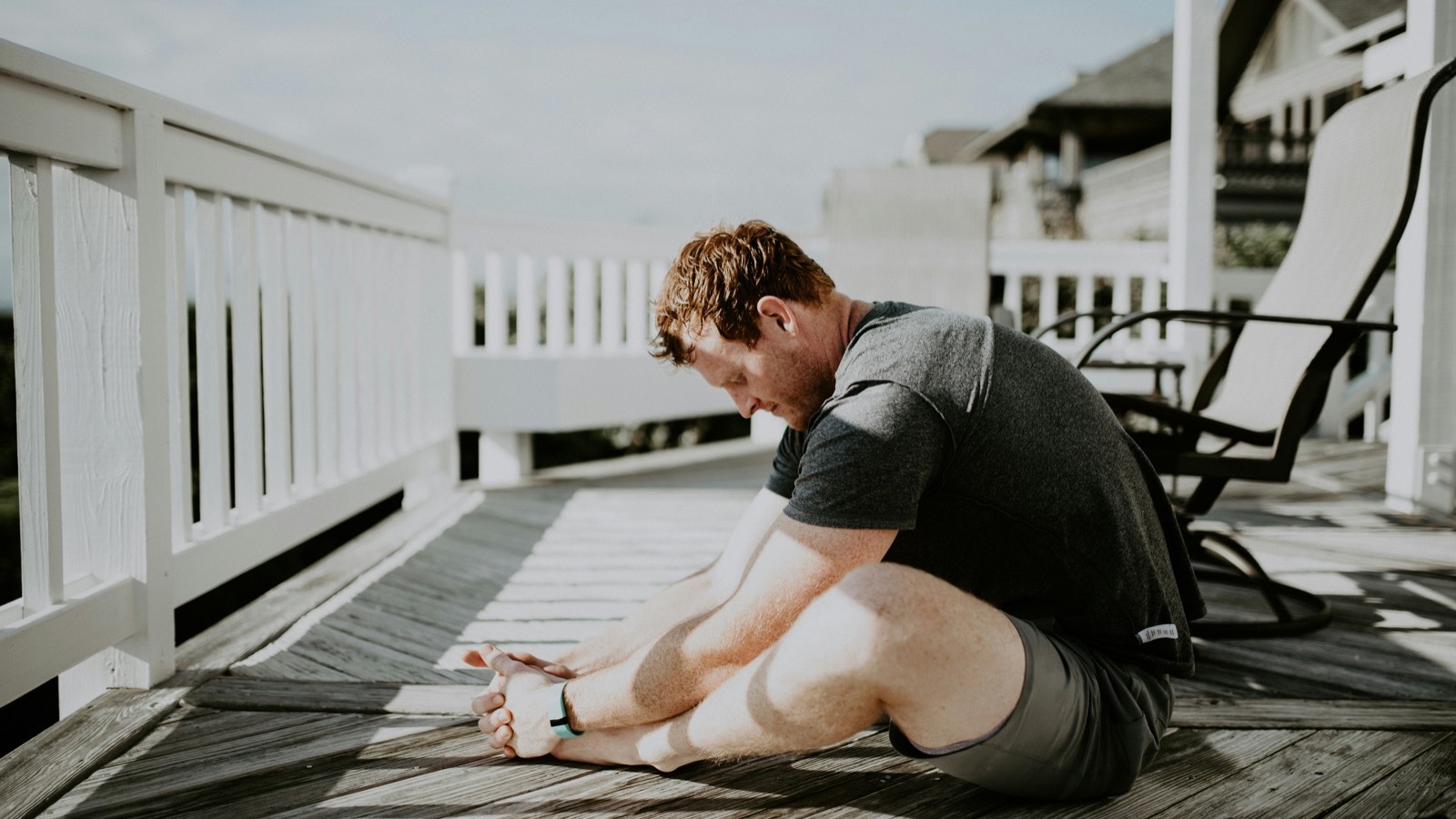
Monday was leg day. Tuesday you felt fine — a little tired, maybe, but fine. Then Wednesday morning arrived, and you discovered that sitting down, standing up, and especially walking down stairs had become a genuine life challenge. Your quads are screaming, and you're pretty sure this isn't normal. Is it? Did you do something wrong? Should you go to the doctor?
Relax — you've just met DOMS: Delayed Onset Muscle Soreness. It's the single most common training experience on the planet, and almost everyone who has ever exercised has been through it. It's uncomfortable, it's annoying, and it makes stairs your mortal enemy. But it's also completely normal, temporary, and — in most cases — nothing to worry about.
Here's what DOMS actually is, why it happens, how to tell it apart from a real injury, and what science says actually helps (spoiler: a lot of the popular advice is overrated).
TL;DR
- DOMS is the muscle soreness that peaks 24–72 hours after exercise — hence "delayed onset." It usually fades within 5–7 days.
- It's caused by microscopic muscle damage from unfamiliar or intense exercise — especially eccentric movements (lengthening under load, like lowering a weight or running downhill). It is not caused by lactic acid, which clears from your muscles within about an hour.
- Soreness is NOT a reliable sign of a good workout or muscle growth. It's mostly a sign of novelty — your muscles doing something new.
- The "repeated bout effect" is real: the same workout causes far less soreness the second and third time. This is your body adapting.
- Gentle movement, sleep, and protein help. Ice baths and anti-inflammatories might dull the ache but can blunt your training adaptations. And if the pain is sharp, one-sided, or comes with swelling — that's not DOMS, that's a possible injury. See a professional.
YouTube: Related video
What DOMS actually is
Delayed Onset Muscle Soreness is exactly what the name says: muscle soreness that arrives after a delay, rather than during or immediately after exercise. The typical timeline looks like this:
- During and right after exercise: you feel fine, maybe even great (that's the endorphin rush).
- 12–24 hours later: a subtle stiffness creeps in.
- 24–72 hours: soreness peaks. This is the "I can't sit down without holding onto something" window.
- 5–7 days: it gradually fades, usually gone within a week.
The soreness itself feels different from the acute burn you get during a hard set. It's a deep, diffuse ache, often accompanied by stiffness and mild weakness. Your muscles feel tight and tender to the touch, and movements that stretch the affected muscle — like lowering into a squat or walking downstairs — are the most painful.
What's happening under the hood is a well-documented chain of events. Exercise — particularly exercise your muscles aren't used to — causes microscopic damage to muscle fibers, especially at the Z-discs (the structural anchor points inside each fiber). That damage triggers an inflammatory response: immune cells move in, fluid accumulates, and pain receptors get sensitized. Your body is essentially running a controlled repair operation, rebuilding the fibers slightly stronger than before.
This is a normal, healthy part of the adaptation process. Muscle growth and fitness improvements literally come from this damage-and-repair cycle. But it's worth understanding that the soreness is a side effect of the repair process — not the goal of it.
No, it's not lactic acid
One myth needs to die here, and I'm happy to be the one to kill it: DOMS is not caused by lactic acid. You'll still hear this from well-meaning trainers, YouTube commenters, and your uncle who "used to lift." It's wrong.
Lactic acid (more precisely, lactate) is produced during intense exercise and is cleared from your muscles within roughly an hour of finishing. It cannot possibly be hanging around causing soreness two days later. Researchers debunked this decades ago. If someone tells you your Wednesday soreness is "leftover lactic acid," you have my permission to smile, nod, and move on.
The actual culprits are:
- Eccentric contractions. This is the big one. When a muscle lengthens while producing force — lowering a dumbbell slowly, the downhill portion of a run, the descent phase of a squat — the mechanical stress on the fibers is much higher than during shortening (concentric) contractions. Eccentric exercise produces dramatically more muscle damage and soreness than anything else.
- Novel movements. New exercises, new equipment, new ranges of motion, even a new sport. Your muscles have a "familiarity threshold," and anything that crosses it triggers more damage.
- Sudden jumps in volume or intensity. Going from zero to 100, from 3 sets to 6, or from a light week to a heavy week.
This is why your first workout after a long break leaves you wrecked while your 20th identical workout barely registers — it's not that you got tougher, it's that your muscles adapted. That adaptation is called the repeated bout effect, and it's the single best news in this entire post: the second time you do a workout, you'll be significantly less sore. The third time, barely sore at all. Your body is designed to stop hurting from things it's used to.
Why some workouts leave you sore and others don't
Not all soreness is created equal, and understanding why you're sore tells you what to expect next time:
| Type of workout | Soreness risk | Why |
|---|---|---|
| Downhill running or hiking | Very high | Constant eccentric loading on quads |
| Heavy strength training (new program) | High | New stimulus + heavy eccentrics on the lowering phase |
| Long run at easy pace (familiar) | Low–moderate | High volume, but no novelty if you're used to it |
| Cycling (smooth, no hills) | Low | Few eccentric forces — the pedal pushes the muscle |
| Swimming | Low | No impact, low eccentric load |
| Sprinting or plyometrics | Very high | Explosive, high-force, often novel |
One practical takeaway: if you're returning from a break or starting something new, expect soreness and plan for it. Ease in — don't judge your first week by how destroyed you feel, because a lot of that destruction is just novelty. It gets dramatically easier by week three.
DOMS vs. injury: how to tell the difference
This is the question everyone really wants answered: is this normal soreness, or did I actually hurt myself? Here's how to tell them apart:
| Signal | DOMS (normal) | Possible injury |
|---|---|---|
| Onset | Delayed (12–72 hours after) | Often during exercise or immediately after |
| Location | Diffuse, both sides (both quads, both arms) | Localized to one specific spot |
| Type of pain | Dull, achy, stiff | Sharp, stabbing, or tearing |
| With movement | Painful but manageable, eases with warm-up | Pain that worsens with movement |
| Swelling/bruising | Minimal | Significant swelling, bruising, or deformity |
| Weakness | Mild, recovers within days | Marked weakness that persists or worsens |
A good rule of thumb: DOMS is symmetrical and predictable. If you did squats, both quads hurt. If the pain is on one side only, came on sharply, or is accompanied by swelling or bruising — that's a red flag. And if you can't bear weight on a limb, or the pain hasn't improved after a week, see a doctor or physiotherapist. When in doubt, get it checked. A week of lost training is a tiny price for ruling out a real injury.
Does soreness mean you had a good workout?
I'm going to answer this one directly because it's the most common misconception in all of fitness: no. Soreness is not a reliable indicator of a good workout, muscle growth, or progress.
Here's why. Soreness tracks novelty and damage, not stimulus quality. You can get brutally sore from a terrible, chaotic workout — and you can make excellent, measurable progress on a well-structured program that leaves you barely sore at all. In fact, as you get fitter, you'll notice the same workouts that used to cripple you now produce almost no soreness. Does that mean they stopped working? No. It means you adapted — which is the entire point of training.
Studies comparing people who get very sore with people who don't show similar muscle growth over time. Soreness is simply not part of the growth equation in a meaningful way. Judge your training by what actually matters: are you getting stronger, faster, fitter? Is your performance trending up? Is your recovery score stable and healthy? Those are the numbers that count. Soreness is just noise.
What actually helps with DOMS (and what doesn't)
The good news: DOMS resolves on its own, usually within a week, and nothing you do will speed up muscle repair dramatically. The realistic goal is symptom relief — taking the edge off while your body does its work. Here's what the evidence says:
| Remedy | Does it help? | The evidence |
|---|---|---|
| Light movement / walking | Yes | Gentle activity increases blood flow and reduces stiffness. "Motion is lotion" is real. |
| Foam rolling | Mildly | Small but consistent reductions in soreness and improvements in range of motion — worth doing, not magical. |
| Massage | Yes | The best-supported hands-on option; reduces soreness and perceived fatigue, though effects are modest. |
| Heat (warm bath, heating pad) | Mildly | Improves blood flow and comfort. Some evidence it helps more than cold for DOMS. |
| Cold water immersion | Mixed | Reduces soreness, BUT may blunt muscle growth and adaptation when used right after training. |
| NSAIDs (ibuprofen) | Mixed | Dulls the ache but can interfere with the muscle repair signaling that makes you adapt. Not a habit worth forming. |
| Stretching | Barely | Feels nice, but research shows almost no effect on DOMS. Don't skip it — just don't expect miracles. |
| Ice baths for prevention | Questionable | Same trade-off as cold immersion: comfort now, possibly less adaptation later. |
The pattern is worth noticing: things that reduce inflammation aggressively (ice, ibuprofen) take the edge off today but may cost you adaptation tomorrow. For most people, the smart play is simple:
- Move gently. A walk, some easy cycling, or light yoga on sore days. It genuinely helps.
- Sleep. Muscle repair happens mostly while you sleep. Soreness + poor sleep = slower recovery. This is non-negotiable.
- Eat enough protein. Repair needs building blocks. Spread your protein across the day rather than one giant dinner.
- Stay hydrated. Nothing dramatic, but dehydration makes everything worse.
- Roll or massage the area. A few minutes of self-massage or foam rolling for the short-term relief.
Should you train when you're sore?
Short answer: it depends, but usually yes — just not the same muscles at high intensity.
Here's the framework I use:
- Soreness in the legs, but today is upper body day? Train normally. The soreness won't interfere.
- Sore from a new workout, but you feel otherwise fine? Light activity is great. A recovery walk, easy spin, or mobility session will actually help the soreness resolve faster.
- Same muscle group sore and today's session is hard? This is where judgment comes in. Training a very sore muscle at high intensity increases injury risk and doesn't add much stimulus — you're not stronger when your fibers are already damaged and inflamed. A light "grease the groove" session or an extra rest day is usually the better call.
- Sore PLUS other warning signs? If you're also seeing an elevated resting heart rate, poor sleep, low energy, and a tanked HRV, that's not just local soreness — that's systemic stress. Pushing through it is how overtraining starts. This is exactly the situation where a recovery score earns its keep: it tells you when "I feel fine" is lying to you.
Your body sends signals on multiple channels — soreness is just the loudest one. The quiet ones matter more. Tools like Century AI pull your resting heart rate, HRV, and sleep together into a daily recovery score, so you can see whether your soreness is a normal training response or part of a bigger recovery problem. Sore legs with a green recovery score? Enjoy the walk. Sore legs, red score, and terrible sleep? Take the rest day.
How to prevent DOMS in the first place
You can't avoid DOMS entirely — novelty is part of training, and first-time soreness is the initiation fee. But you can stop it from wrecking your week:
- Progress gradually. The classic "10% rule" (don't increase volume or intensity by more than ~10% per week) exists for exactly this reason.
- Ease into new things. First week of a new program, new sport, or post-break training? Do less than you think you need. The repeated bout effect means you'll be able to handle more next week.
- Warm up properly. A proper warm-up doesn't prevent DOMS completely, but it reduces the shock of the first working sets.
- Don't chase soreness. If you find yourself hoping to be sore after every workout, remember: soreness is a side effect, not a goal. Your progress is measured in performance and recovery, not in how hard the stairs are the next morning.
The takeaway
DOMS is your body's way of saying "that was new, and I'm upgrading myself to handle it better." It's uncomfortable, it's temporary, and — unless the pain is sharp, one-sided, or swollen — it's completely normal. It's not lactic acid, it's not a sign you trained "wrong," and it's definitely not proof of a good workout.
What actually matters is what you do next: move gently, sleep well, eat enough protein, and let your recovery signals — not your soreness — decide whether today is a push day or a rest day. Train consistently, progress gradually, and the soreness fades into the background while the fitness stays.
Century AI helps you understand your body with a daily health score, recovery score, and sleep insights — using the watch you already wear.